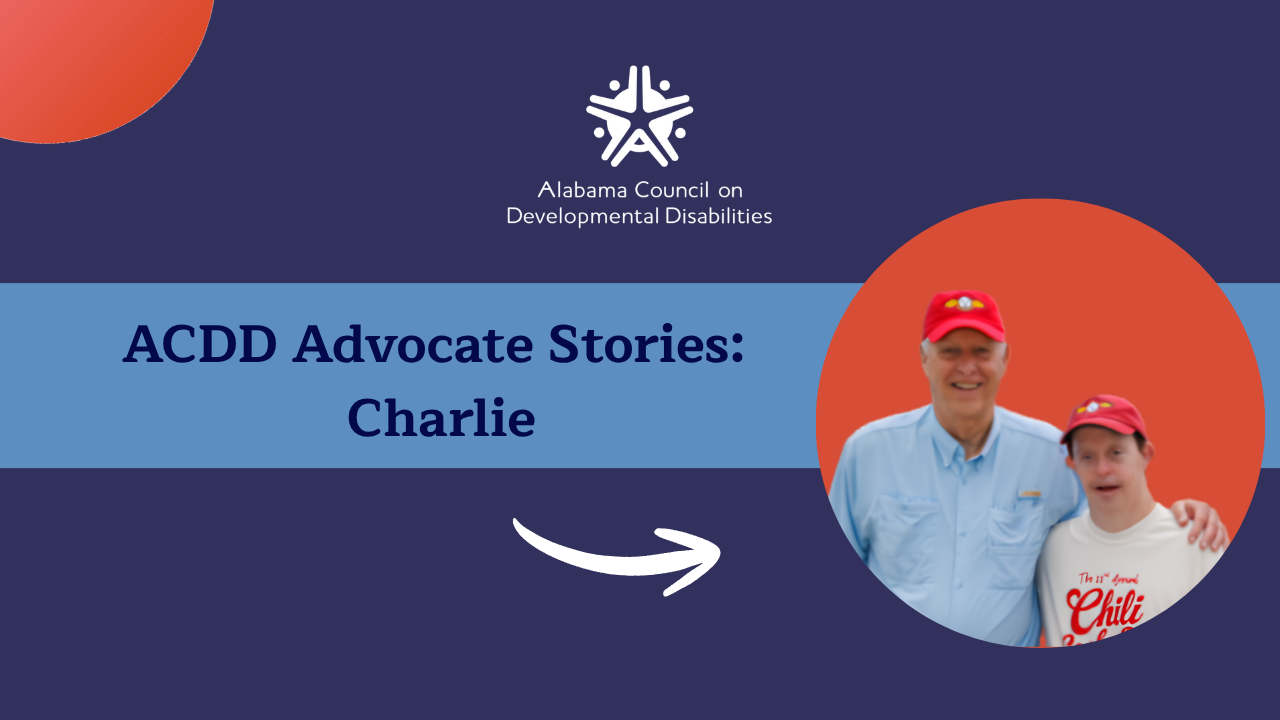
ACDD Advocate Stories: Charlie

Charlie’s Story: Advocacy That Started at Home

Based in Birmingham, Alabama, Charlie is a father and community advocate. His journey into advocacy began with his son Andy, who was born with Down syndrome nearly 50 years ago. Like many parents, Charlie and his wife were learning along the way. They focused on helping Andy grow, learn, and be part of everyday life.

“We didn’t really know what we were doing when Andy was born,” Charlie has shared. “We just said we were going to try to make life as normal as possible and help him be part of everything.”

As Andy grew up, Charlie and his wife helped him build independence through simple daily routines. The goal was always to help him build confidence and stay connected to the world around him.

Andy’s Life Today

Today, Andy lives an active life in the community. He has worked at a local Publix grocery store for more than 20 years. Many customers know him and look forward to seeing him at work. His job gives him purpose and keeps him connected to people in his community.

Andy lives at home but has his own space upstairs where he relaxes, talks with friends, and enjoys his routines. Charlie jokes that one of his main jobs in retirement is driving Andy to and from work. It is a daily routine that keeps Andy active and involved.

Finding the Power of Community Programs

A key part of Charlie’s work began with a small recreation program in Homewood, Alabama. It began as an after-school activity where people with developmental disabilities could play sports and spend time together. Families quickly saw how important it was.

As the program grew, it became clear that more space and support were needed. Charlie stepped in to help raise funds and build something that would last. What began as a small effort eventually became the Exceptional Foundation.

“What started as a small program kept growing because families needed it,” Charlie says. “Now it’s a place where people can come every day, stay active, and be part of a community.”

Today, the Exceptional Foundation serves more than 100 participants each day in a 36,000-square-foot facility. It offers a full-day adult program four days a week, along with recreation programs, after-school activities, and summer programs that help people stay active and connected.

As the organization expanded, leaders focused on keeping programs safe and sustainable. The foundation serves individuals who can take part in group activities with some independence, allowing staff to support many participants at once.

Stepping Into Advocacy

Charlie’s involvement with the Exceptional Foundation eventually led him to serve on the Alabama Council on Developmental Disabilities. In that role, he contributed to conversations about services, programs, and policies that support individuals and families across the state.

He never set out to become an advocate. He simply responded when there was a need.

“If someone asks for help building something that helps people, you step up and do what you can,” Charlie says.

Charlie has seen many changes over the years. When Andy was born, there were fewer programs and fewer supports for families. Today, there are stronger networks and more opportunities for people with developmental disabilities to be active members of their communities.

Andy’s life reflects that progress. He works, stays connected with friends, and takes part in community events. 

Charlie’s story shows what advocacy can look like over time. It begins with family, it grows through community, and it can continue across generations.

2027-2031 Five-Year State Plan: Public Comments Requested

Public Comments Requested

The Alabama Council on Developmental Disabilities (ACDD) is responsible for developing a state plan, which guides the efforts of the Council. The state plan is developed to address the unmet needs of people with developmental disabilities and their families in our state. Councils must prioritize areas, however, because not all the issues experienced by people with developmental disabilities and their families can be addressed by a Council in one state plan.


Therefore, the Council is seeking public input on its draft goals and objectives for its 2027-2031 Five-Year State Plan. Consistent with federal requirements, the draft state plan goals and objectives are being released for a 45-day public comment period beginning on March 30, 2026, and ending on May 13, 2026.


How to Submit Comments

The draft goals and objectives are below. Comments can be submitted in the comment box. Comments can also be mailed to Darryle Powell and/or Melissa Sylvester at the address below. Additionally, you can email your comments to:


Alternate formats are available upon request by contacting one of the individuals above. All public comments will be reviewed, and the Council will decide on how to best address comments received.

Thank you for your time and feedback.


Contact Information

Alabama Council on Developmental Disabilities (ACDD)
RSA Union Building
100 North Union Street, Suite 682
Post Office Box 301410
Montgomery, AL 36130

(334) 242-3976
(334) 242-0246


ACDD 2027-2031 Five-Year State Plan Draft Goals and Objectives


Priority Area: Community Engagement

Goal 1:
Over the next five years, the ACDD will increase information, opportunities, supports, and other assistance to Alabamians with intellectual and developmental disabilities (I/DD), their families, and their support networks so that individuals with I/DD more fully participate in and contribute to the full range of community life.

Objectives:

  • Objective 1.1:
    By 2031, through outreach, education, collaboration, and barrier elimination, the ACDD will support full and active community participation, integration, and inclusion for 500 Alabamians with intellectual and developmental disabilities (I/DD).
  • Objective 1.2:
    By 2031, through coordination and collaboration with state, local, and other partners, the ACDD will support opportunities for 1000 Alabamians with intellectual and developmental disabilities (I/DD), their families, their support networks, and others to receive resources, training, and other assistance so that individuals with I/DD achieve full access to the community.
  • Objective 1.3:
    By 2031, the ACDD will work with partners to decrease one or more barriers to community participation and engagement for Alabamians with intellectual and developmental disabilities (I/DD) and their families who have experienced a state or federally declared natural, man-made, or other disaster or public emergency through outreach, education, coordination, and collaboration (Recommended Emerging Issue, Need, or Trend [Disaster or Public Emergency] Objective).

Priority Area: Employment

Goal 2:
Over the next five years, the ACDD will increase or improve services, supports, and other assistance to enable more Alabamians with intellectual and developmental disabilities (I/DD) to secure competitive, integrated employment.

Objectives:

  • Objective 2.1:
    By 2031, through training, technical assistance, collaboration with stakeholders, and other activities, the ACDD will support opportunities to provide employment related services, supports, and other assistance to 1000 Alabamians with intellectual and developmental disabilities (I/DD), their families, and others so that individuals with I/DD acquire, retain, or advance in competitive, integrated employment.
  • Objective 2.2:
    By 2031, through outreach, training, barrier elimination, and various partnerships, the ACDD will support transition, employment readiness, or other employment related activities for 500 Alabamians with intellectual and developmental disabilities (I/DD), especially unserved and/or underserved populations, so that individuals with I/DD obtain employment certification or credentials and competitive, integrated employment.

Priority Area: Education and Early Intervention

Goal 3:
Over the next five years, the ACDD will strengthen opportunities and provide more information to Alabamians with intellectual and developmental disabilities (I/DD), their families, and others to enable individuals with I/DD to access services and supports, maximize their educational potential, and benefit from lifelong learning activities.

Objectives:

  • Objective 3.1:
    By 2031, through collaboration with partners, education, and other activities, the ACDD will increase awareness of and/or access to available services and supports related to education (K-12) and early intervention to address the needs of 1000 Alabamians with intellectual and developmental disabilities (I/DD) and their families.
  • Objective 3.2:
    By 2031, through training, technical assistance, coordination, and other activities, the ACDD will increase the capacity of 1000 professionals in education (K-12) and early intervention to better serve and support Alabamians with intellectual and developmental disabilities (I/DD) and their families.

Priority Area: Advocacy

Goal 4:
Over the next five years, the ACDD will increase resources, training, and other opportunities to Alabamians with intellectual and developmental disabilities (I/DD), their families, their support networks, and other allies so that individuals with I/DD live more freely of abuse, neglect, exploitation, and rights violations.

Objectives:

  • Objective 4.1:
    By 2031, through education, collaboration, and other activities, the ACDD will provide resources, training, and other opportunities to 500 Alabama families of people with intellectual and developmental disabilities (I/DD) so that family members are more effective and/or active in family and systems advocacy.
  • Objective 4.2:
    By 2031, through training, coordination, and coalition development, the ACDD will support opportunities for 250 individuals with intellectual and developmental disabilities (I/DD) to develop leadership and advocacy skills, train others with I/DD, contribute to a statewide self-advocacy organization led by people with I/DD, participate in other disability leadership coalitions, and educate policymakers about their needs and interests. (Self-Advocacy Requirement)


Please provide comments regarding the above draft goals and objectives by filling out the form below.


    ACDD Advocate Stories: David

    David: A Clear Voice for Advocacy

    David was born in Tuscaloosa, where music shaped his life from the very beginning. His biological father was a musician who lived in another state but would often visit. During those visits, they made music together, and his father would sometimes bring him new tapes or musical equipment, like a keyboard. 

    “Music’s been my life,” David says. From an early age, it gave him direction, discipline, and a way to express himself.

    When he was four, he moved to Maryland, but Tuscaloosa always remained home in his mind. He had always planned to return, and in 2009, he did. After moving back, David enrolled at the University of Alabama to study music. He joined the Afro-American Gospel Choir and became head musician in 2013. He continued in that role long after graduation. Today, he also serves as music director at Mount Pilgrim Missionary Baptist Church, where he leads, arranges, and supports other musicians.

    Diagnosis, Identity, and Self-Understanding

    David was born blind due to optic nerve hypoplasia. Near the end of his time at the University of Alabama, he was also diagnosed with autism. When he received the diagnosis, he said, “I knew it. That makes me feel a lot better.”

    The diagnosis gave him language for experiences he had struggled to explain. As a child, he had strong texture sensitivities with food. That required patience and creative problem-solving from his mother and teachers. More broadly, the diagnosis helped him understand his thinking style, communication preferences, and need for predictability.

    Early Support and Foundations

    Independence for David developed over time. With support from family and early educators, including his preschool teacher Betsy Williams, he began building strong foundations early on.

    David remembers Miss Betsy as more than a teacher. Along with her co-teacher, Kim Wenth, she created a caring environment that helped him navigate early challenges and build confidence. Miss Betsy’s recent passing deeply touched him. Shortly before she passed, David shared a tribute on Facebook dedicating the song “One Moment in Time” by Whitney Houston to her.

    Technology and Daily Life

    Today, David manages his own schedule and finances. He uses assistive technology daily, including JAWS and NVDA screen readers, along with an Apple Watch and AirPods to communicate and stay organized. He records and produces music using Logic Pro on a Mac.

    Self-advocacy is part of that independence. When his apartment complex was planning to replace carpet with hard flooring, David explained that carpet helps him distinguish rooms by sound and feel. Management ended up replacing the carpet with new carpet as a resolution.

    From Music to Leadership

    While studying at the University of Alabama, David began in music therapy. He later switched to a general music degree with a minor in sociology. 

    More recently, David became the acting director of People First, an organization led by and for people with intellectual and developmental disabilities. After longtime director Susan Ellis passed away, the organization faced funding cuts and instability. David stepped in to keep the work moving.

    His focus has been practical. He is pursuing grants, building partnerships, and strengthening ties with broader advocacy networks. He wants the organization to be stable and sustainable.

    Advocacy in Practice

    David stays active in his community. He participates in advocacy training, attends public events, and supports others navigating complex systems. He also continues to lead through music. Singing at church and directing the gospel choir helps him build connections and visibility.

    His journey reflects the spirit of Developmental Disabilities Awareness Month: people with disabilities have always been part of our communities. They are leaders today. And they will continue shaping what comes next.


    ACDD Advocate Stories: Cordairo

    Cordairo: Speaking Up, So Others Can Move Forward

    Cordairo grew up in Monroeville, Alabama, in a close-knit community where everyone knew one another. His grandmother and great-grandmother raised him, while his mother worked to support the family. It was a close household, and that support system shaped how he approaches life.

    When he was 16, he was in a four-wheeler accident that left him paralyzed from the chest down. He fractured bones in his neck and spent weeks in the hospital. Early on, he needed a ventilator to breathe and developed pneumonia. After leaving the hospital, he had to relearn everyday tasks like feeding himself and getting dressed.

    Over time, he regained strength in his arms. In 2005, he received a Baclofen pump to manage severe muscle spasms, which increased his comfort and independence. Today, he manages most aspects of his daily life independently, including scheduling appointments, ordering supplies, and managing his finances.

    He sees independence as something that develops gradually. For him, it begins with mindset.

    “If your mind doesn’t evolve, you don’t evolve,” he explains.

    From Personal Experience to Public Policy

    In 2013, he testified at the Alabama State Capitol about Medicaid expansion and its impact on people with disabilities. That experience showed him how personal stories can influence policy decisions.

    He later became involved with the Alabama Council of Developmental Disabilities, focusing on practical policy issues that affect daily life. One area he worked on was reducing delays in wheelchair repairs.

    “Your wheelchair is your freedom,” he shares.

    When repairs take too long, people can miss work, school, and medical appointments. Loaner chairs often don’t fit properly and may cause discomfort. Cordairo and other advocates met with lawmakers to explain how these delays affect real people. Their efforts contributed to legislation aimed at improving the repair process.

    Expanding Advocacy to Criminal Justice Reform

    More recently, he has focused on supporting people with intellectual and developmental disabilities who become involved in the criminal justice system. Through advocacy training, he learned how policy works and how to engage effectively with legislators. During that process, he noticed a gap: there was no clear, accessible information for people with IDD who are leaving jail or prison.

    He is now developing a resource guide that will outline legal rights, voting eligibility, available services, and how to reconnect with community supports. It will also include information on job training and disability services that can help reduce the likelihood of returning to the system.

    “You already have a strike against you,” he says. “But you still have rights. You still have access. People just need to know where to look.”

    Building Change, Step by Step

    For Cordairo, advocacy is about improving systems in practical ways. It’s about making sure policies reflect how people actually live. He focuses on what can be changed and continues building from there.

    Cordairo’s journey reflects this year’s Developmental Disabilities Awareness Month theme, WE’RE HERE. THEN, NOW, ALWAYS. 

    From lived experience to policy change, people with disabilities have always been part of our communities, are active contributors today, and will continue shaping what comes next.


    ACDD 2027-2031 Five-Year State Plan Development Listening Session

    ACDD 2027-2031 Five-Year State Plan Development Listening Session
    The Alabama Council on Developmental Disabilities (ACDD) is developing its 2027-2031 Five-Year State Plan and we need input about the needs of individuals with developmental disabilities and their families in our state. There will be a virtual listening session for the general public on Thursday, November 20, 2025, at 2:30 PM (CT). Click on the flyer link below for more details. If you have any questions, then please send an email to darryle.powell@mh.alabama.gov or melissa.sylvester@mh.alabama.gov or call (334) 242-0246 or (334) 242-3976. Please join us and/or share and invite members of your support network.

    ACDD Public Forum Flyer_November 2025 Session

    make your voice heard

    Help ACDD Build Its Next Five-Year State Plan for 2027-2031

    ACDD 2027-2031 Five-Year State Plan Input Survey

    The Alabama Council on Developmental Disabilities (ACDD) is developing its 2027-2031 Five-Year State Plan and we need input about the needs of individuals with developmental disabilities and their families in our state. Please answer the following questions to provide input. Alternate formats are available upon request. If you have any questions, then please send an email to darryle.powell@mh.alabama.gov or melissa.sylvester@mh.alabama.gov or call (334) 242-0246 or (334) 242-3976.

    We need your voice. Visit our website at acdd.org

    English:

    ACDD State Plan Input Survey in English

    https://www.surveymonkey.com/r/acdd2731stateplan

    QR Code English Survey


    Necesitamos su voz Visite nuestro sitio web en acdd.org

    Spanish:

    ACDD State Plan Input Survey in Spanish

    https://es.surveymonkey.com/r/spanishacdd2731stateplan

    QR Code Spanish Survey